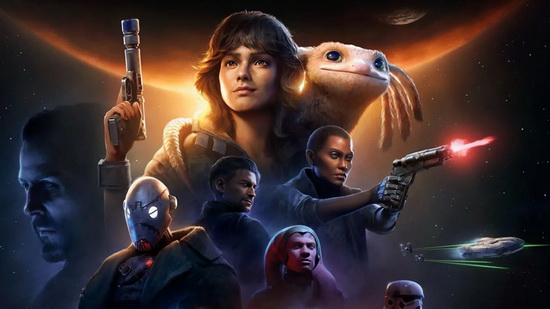
It’s three in the morning in Tokyo,and somewhere in a Sony boardroom,a spreadsheet just won an argument against common sense.They’ve just announced the next batch of PlayStation Plus games,and if you’re not feeling a specific kind of vertigo right now,you haven’t been paying attention to the math of desperation.Leading the charge is Star Wars Outlaws—a$70 triple-A behemoth from 2024 that is still technically in its paid-advertisement prime,yet here it is,being thrown into the subscription grinder like a Hail Mary pass from a quarterback who just heard footsteps.This isn't a gift;this is a white flag waved at a 4K resolution.And then,right next to that shiny,troubled outlaw,they’ve strapped a certified zombie:Red Dead Redemption II.Yes,the game that cost nearly half a billion dollars to make,the one that lives inside your hard drive like a guilt-ridden ghost you keep promising to replay but never do.Rockstar’s magnum opus about the death of the frontier is now just another line item in your monthly fee,a magnificent corpse resurrected not for art,but for retention metrics.Sony isn't curating a library;it's performing a séance,trying to summon the ghost of“value”in an era where gamers are hoarding their cash like doomsday preppers.You can feel the panic in the binary:when you need to prop up a subscription service,you don’t reach for indie darlings—you reach for the heaviest,most expensive wood you can find to keep the fire burning.
But this is where the story stops being about corporate strategy and becomes something ugly and beautiful and entirely human,because hiding at the bottom of the press release,almost as an afterthought,is Time Crisis.For the vast majority of you with PlayStation Plus Extra,the headline is just“Star Wars and Red Dead,”and sure,you’ll download them,you’ll play for forty minutes,you’ll feel a mild dopamine hit,and then you’ll go back to staring at your backlog.But for the freaks—and I mean that as the highest possible compliment—the ones who pay for Premium,you just got the keys to a dead mall.Time Crisis isn’t a game;it’s a memory of a specific kind of sweat.It’s the smell of cheap pizza and spilled soda in an arcade cabinet where the plastic light gun was chained to the console so no one could steal it.When you boot that up,you aren't playing a classic;you're visiting a graveyard where your youth is buried.You’ll sit there,alone in your living room,pointing a DualSense at a flat screen,and you’ll realize that the delay isn't in the input lag—it’s in your wrists.You aren't as fast as you were in 1997.And that realization,that tiny heartbreak of latency,is worth more than the entire open world of Red Dead Redemption II.Sony knows this.They dangled the cowboy and the scoundrel to get you in the door,but the Time Crisis inclusion is a psychological scalpel.It’s designed to make the Premium price tag hurt just a little less,to trick your amygdala into believing that$160 a year is a bargain because you get to“Gun Survive”one more time.It’s the same trick every drug dealer uses:the first hit of nostalgia is free,but the maintenance dose costs you a subscription.
So go ahead,claim your monthly games.Download the sprawling epic and the blockbuster license.But when you scroll past them in your library next month,buried under the avalanche of new releases you also don't have time for,remember this moment.This is the state of the art in 2026:subscription services aren't selling you games anymore.They are selling you the absence of regret.They are betting that you would rather pay a recurring fee to own nothing than feel the sting of paying$70 for a game you might hate.And the most tragic part?They are probably right.The only honest thing left in this entire ecosystem is that light gun pointing at a CRT television that no longer exists.Pull the trigger,cowboy.Your quarterly report is waiting.


