You don’t survive cosmic horror.You just postpone the screaming.Professor Harry Everhart learned that decades ago on a cursed Pacific island.He made it home,sure.But the visions followed.Now,an engineering student named Evangeline Drayton is having the same dreams—civilizations that never existed,geometries that hurt to remember.When fate shoves them together,Call of the Elder Gods does something rare:it turns trauma into a two-player puzzle box where only one of you holds the real clue.
The 2020 original was a lonely fever dream.This sequel is a buddy road trip through hell,and I mean that as a compliment.You’ll solve riddles in a storm-battered mansion,an abandoned snow facility,the Australian desert,and places that don’t belong on any map.The visuals finally breathe because the premise finally travels.But here’s the catch:Harry the archaeologist and Evangeline the engineer don’t have unique abilities.No grappling hooks.No magic.Instead,you switch between them to tackle problems that require two heads—like using Harry to open rooms while Evangeline dodges a supernatural threat.These tandem puzzles are fine.I wanted more of them,because they’re the only thing the first game couldn’t do.
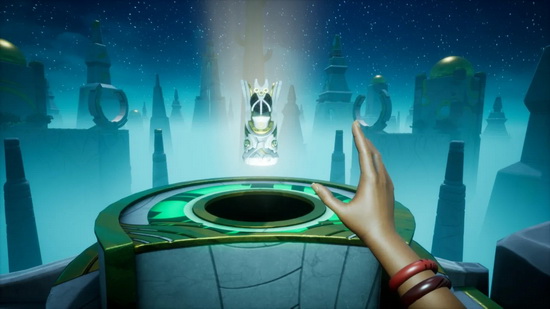
What impressed me also perplexed me.Deciphering otherworldly musical notes on ancient instruments?Brilliant.Uncovering cult member details to access inner chambers?Satisfying.But your journal—your supposed lifeline—is sometimes a liar.You’ll find every clue scattered across an area,record the key info,and still stare at your notes for an hour because one phrase stopped short of context.The worst offender:a cable-to-socket matching exercise that turns into a guessing game.Yes,there’s a penalty-free hint system that builds from gentle nudges to outright solutions.Use it.No shame.Some puzzles dump a buffet of notes and photographs before you even understand the problem,and sifting through that much out-of-context information at once is overwhelming.Worse,certain useful clues never get recorded in your journal at all.Want to cross-reference a hunch?Go physically find the clue again.That’s not difficulty.That’s paperwork.
The seven-hour story,narrated by original protagonist Norah Everhart,has neat twists and a good emotional core—both leads are motivated by lost loved ones.But Evangeline and Harry aren’t memorable.The villains are even less so.One major foe’s fate unfolds anticlimactically.The character models won’t wow you,and the illustrated cinematics feel budget.But the voice performances?Strong.Real gravitas.
Here’s the thing.Since Call of the Sea dropped,narrative-puzzle games have gotten smarter,tighter,more elegant.Call of the Elder Gods isn’t the best of them.But it is the most honest about what madness actually feels like:not terror,but confusion.Staring at a journal that forgot to help you.Walking back to a photograph you saw two hours ago because the game didn’t save that note.Guessing which cable goes where while a cosmic threat waits.Harry and Evangeline would tell you to stay sane.Don’t listen.Embrace the insanity-inducing madness with open arms.Get stuck for an hour.Feel stupid.Then solve it.That’s the whole point.


