I adore the 1995 Yoshi's Island.The stressful,beautiful screaming-baby-carrying masterpiece that taught an entire generation that platformers could feel like anxiety.So when I sat down with Yoshi and the Mysterious Book,I did what old fans do:I braced for the fall.But this Yoshi doesn't drop you.He literally cannot take damage.Falling into a bottomless pit just teleports you back to safety like a concerned parent who has already put foam pads on every corner of the living room.At first,I was offended.Where is the edge?Where is the gnashing of Shy Guy teeth?But then I realized I was asking the wrong question.The real question is:why did I need Yoshi to suffer to feel like I was playing a real game?
This is not a retread of 1995.That is the first and most important thing to admit.Yoshi and the Mysterious Book has no obligation to be the game I played at eleven years old while eating too many Gushers,and thank goodness it isn't.This plays like a puzzle game wearing Yoshi's skin.You still eat creatures.You still throw eggs.We have been doing that for three decades,and the muscle memory is so deep it lives in my spine.But the book does not fight you.The closest thing to a traditional death is falling,and even that is just a gentle reset.I almost called it a"cozy game"in my notes,then deleted it twice,then wrote it again.It is cozy.That word is fuzzy and overused,but watch Yoshi move through the pages of Mr.E's world.His stilted,stop-motion shuffle is inviting.The paper visuals are so warm you could press your face against them.
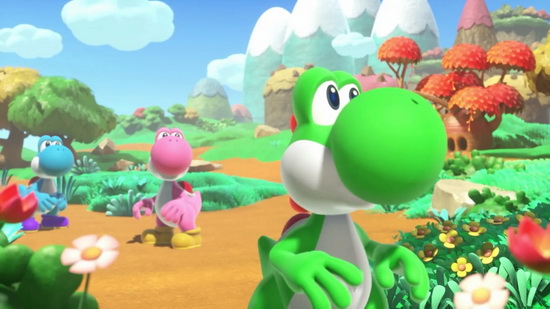
The real reward here is not overcoming a jump that killed you twelve times.The reward is accidental joy.I got mud all over a flower character riding my back,then ran through water and watched the mud wash off.The game pointed at it,marked it down in the book,and said,"Isn't that neat?"And I agreed.I actually agreed.That is the dangerous magic of this game.It makes you feel acknowledged for noticing small,tender interactions instead of punishing you for missing a pixel-perfect platform.But I have to be honest:it is less fun when the solution is vague."Look for a cave somewhere"is not a puzzle.That is a chore.Eating all the butterflies to trigger progress feels arbitrary,not clever.Thankfully,you can buy hints,and few puzzles are real walls.But that also means there is not much incentive to find everything beyond simple curiosity.And curiosity,as it turns out,is enough for about two thirds of the playtime.
Then the credits roll.This is the halfway point.Recent Nintendo games love this structure,and I have mixed feelings.But here,after the credits,something shifts.The tools get weirder.The nostalgic references hit harder.The levels feel less like a tutorial for a game that refused to hurt you and more like a celebration of a game that trusted you to relax.My inconsistent feeling of reward never fully goes away.Some puzzles still feel like guessing games.But the game opens up in a way that forgives its own flaws.
Let me say something vulnerable.I pined for the stress.I wanted Yoshi to carry a helpless baby while the screen shook and my pulse raced.That is what I associate with this green dinosaur.But Yoshi and the Mysterious Book is not that game,and maybe I do not need it to be.This is a pleasant vacation where all the animals want to be friends and the soundtrack sounds like colorful bubbles bursting in front of a double rainbow.It is potentially Yoshi's lowest-stakes adventure ever made.And in a year when everything demands my urgency,my anger,my optimization,my perfect parry timing—a game that simply says"Isn't that neat?"and means it?That is not a lack of ambition.That is a different kind of bravery.Yoshi finally gets to rest.I just did not know I needed permission to rest too.


